Crankset comparison · October 2026 · Velo-Perso.com
Weight, aerodynamics, compatibility: compare before upgrading
A lighter crankset can change how your bike feels. But the right choice also depends on spindle compatibility, chainring sizes, stiffness and, in some cases, aerodynamic integration.
This table compares complete cranksets with chainrings (excluding pedals and bottom bracket), mainly with 170 mm crank arms. It clearly separates weights checked by Velo-Perso from manufacturer figures.
01 / The figures that matter
Crankset weight comparison in grams
Main reference: crank arms of 170 mm. Two QO cells include a real-world measurement with 165 mm crank arms: 571 g for the RACE Light 50/34 and 672 g for the RACE AERO 54/40. Each exception is labelled directly in the table. A dash (—) means no reliable comparable measurement was available for that configuration; it does not necessarily mean the setup is unavailable.
| Brand · crankset | 50/34 | 52/36 | 53/39 | 54/40 |
|---|---|---|---|---|
| Rotor Aldhu CarbonCarbon · 30 mm spindleVelo-Perso measurements | 550 | 563 | 601 | — |
| QO RACE LightCarbon · DUB 28.99 mm spindleWeighed by Velo-Perso | 571 g165 mm · VP measured | — | — | — |
| QO RACE AEROCarbon · aero spider and outer ring · DUB 28.99 mm spindleVP measured + manufacturer | 624 g170 mm · manufacturer | — | — | 672 g165 mm · VP measured |
| Rotor Aldhu 30Aluminium · 30 mm spindleVelo-Perso measurements | 650 | 663 | 701 | — |
| Rotor Vegast 30Aluminium · 30 mm spindleVelo-Perso measurements | 680 | 693 | 731 | — |
| Shimano Dura-Ace FC-R920024 mm spindle · no power meterManufacturer | 685 | 692 | — | 714 |
| Shimano Ultegra FC-R810024 mm spindle · no power meterManufacturer | 700 | 711 | — | — |
| Rotor Aldhu 24Aluminium · 24 mm spindleVelo-Perso measurements | 720 | 733 | 771 | — |
| Rotor Vegast 24Aluminium · 24 mm spindleVelo-Perso measurements | 745 | 758 | 796 | — |
| Shimano 105 FC-R710024 mm spindle · no power meterManufacturer | 754 | — | — | — |
The custom colour scale ranks the displayed weights from soft green (lighter) to soft red (heavier). It adjusts to your filters, while grams are always shown.
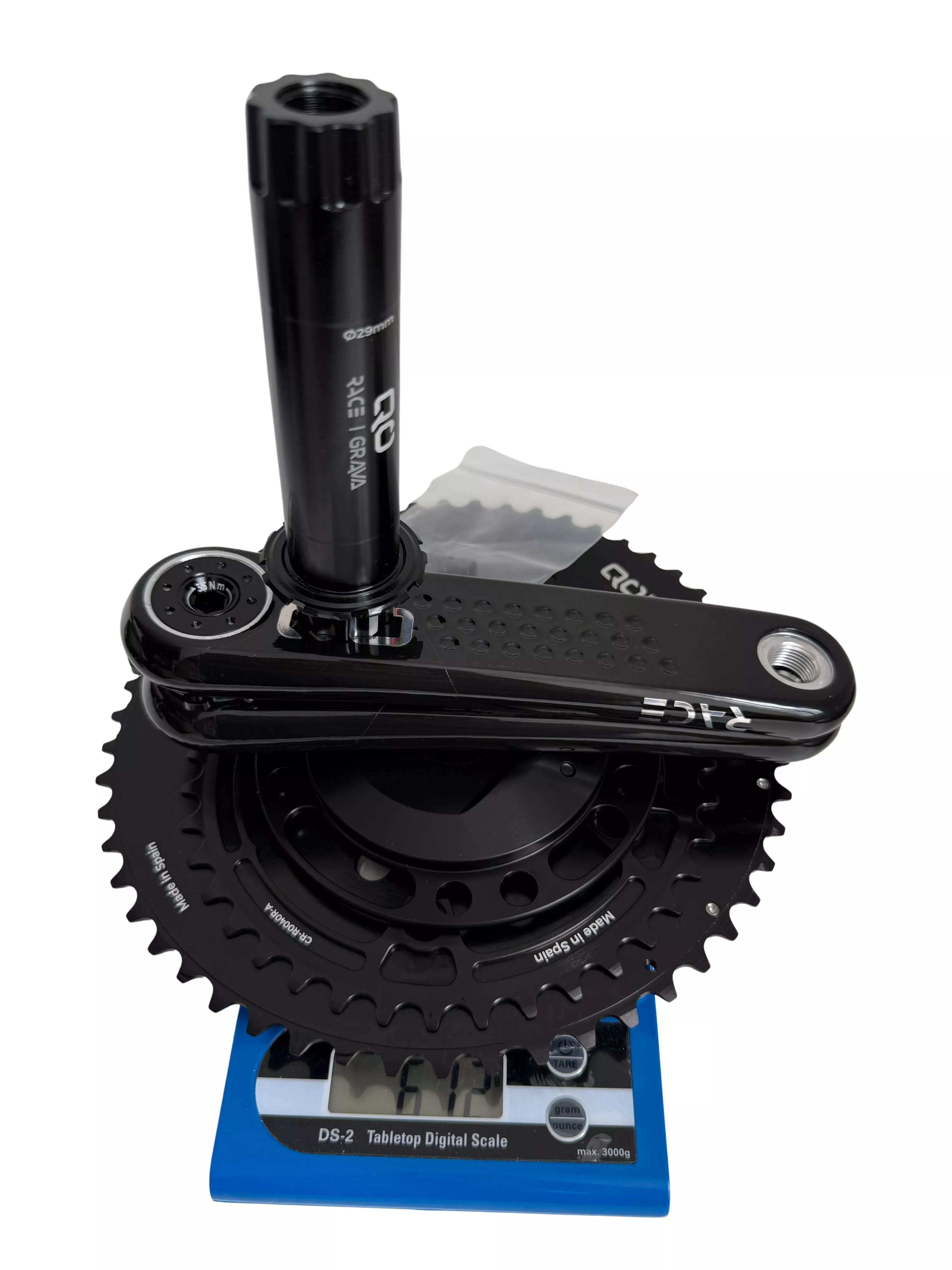
Sources: Velo-Perso comparisons and workshop measurements; verified Velo-Perso weights: QO RACE Light 571 g in 165 mm / 50-34 (photo 6095) and QO RACE AERO 672 g in 165 mm / 54-40 (photo 5995) ; QO RACE AERO manufacturer specifications (624 g in 170 mm / 50-34) ; QO RACE Light manufacturer specifications (560 g in 170 mm / 50-34). For each model, consult its Velo-Perso product page for current configurations and availability.
02 / Two approaches to carbon cranksets
QO RACE AERO vs RACE Light: what is the difference?
Both use carbon crank arms and a DUB-compatible 28.99 mm spindle, with 50/34, 52/36 and 54/40 gearing options. The main difference lies in the spider and chainring design: a more enclosed aerodynamic profile on the AERO, lower weight on the Light. Two Velo-Perso measurements illustrate the distinct setups: 571 g for the RACE Light in 165 mm / 50-34 and 672 g for the RACE AERO in 165 mm / 54-40. The chainring combinations differ, so the 101 g difference cannot be attributed to aerodynamic parts alone.
QO RACE AERO
Velo-Perso measurement: 165 mm / 54-40. A distinctive, integrated design with a more enclosed spider and outer chainring. This construction may reduce aerodynamic drag compared with an open design, depending on the bike and conditions. Its weight remains competitive for a 54/40 aero configuration; no measured watt saving is claimed.
Velo-Perso scale: 672 g in 165 mm / 54-40 · Manufacturer: 624 g in 170 mm / 50-34
Explore QO RACE AERO →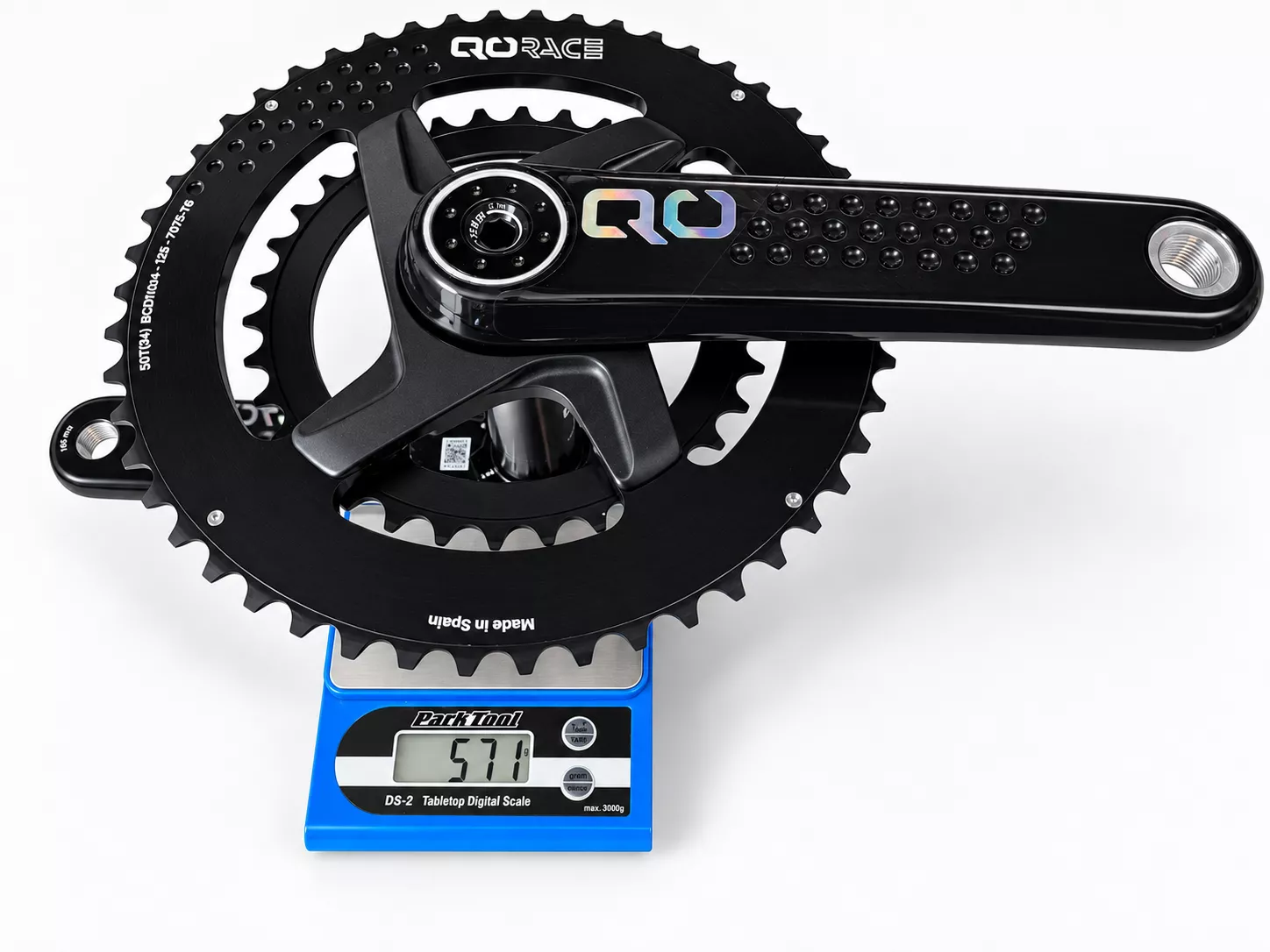
QO RACE Light
571 g verified on the Velo-Perso scale for a complete crankset in 165 mm / 50-34. An excellent result for a carbon road crankset. In the same manufacturer configuration (170 mm / 50-34), QO claims 560 g for the Light versus 624 g for the AERO: 64 g lighter. Do not confuse this manufacturer comparison with our measurements on different configurations.
Velo-Perso scale: 571 g in 165 mm / 50-34 · Manufacturer: 560 g in 170 mm / 50-34
Explore QO RACE Light →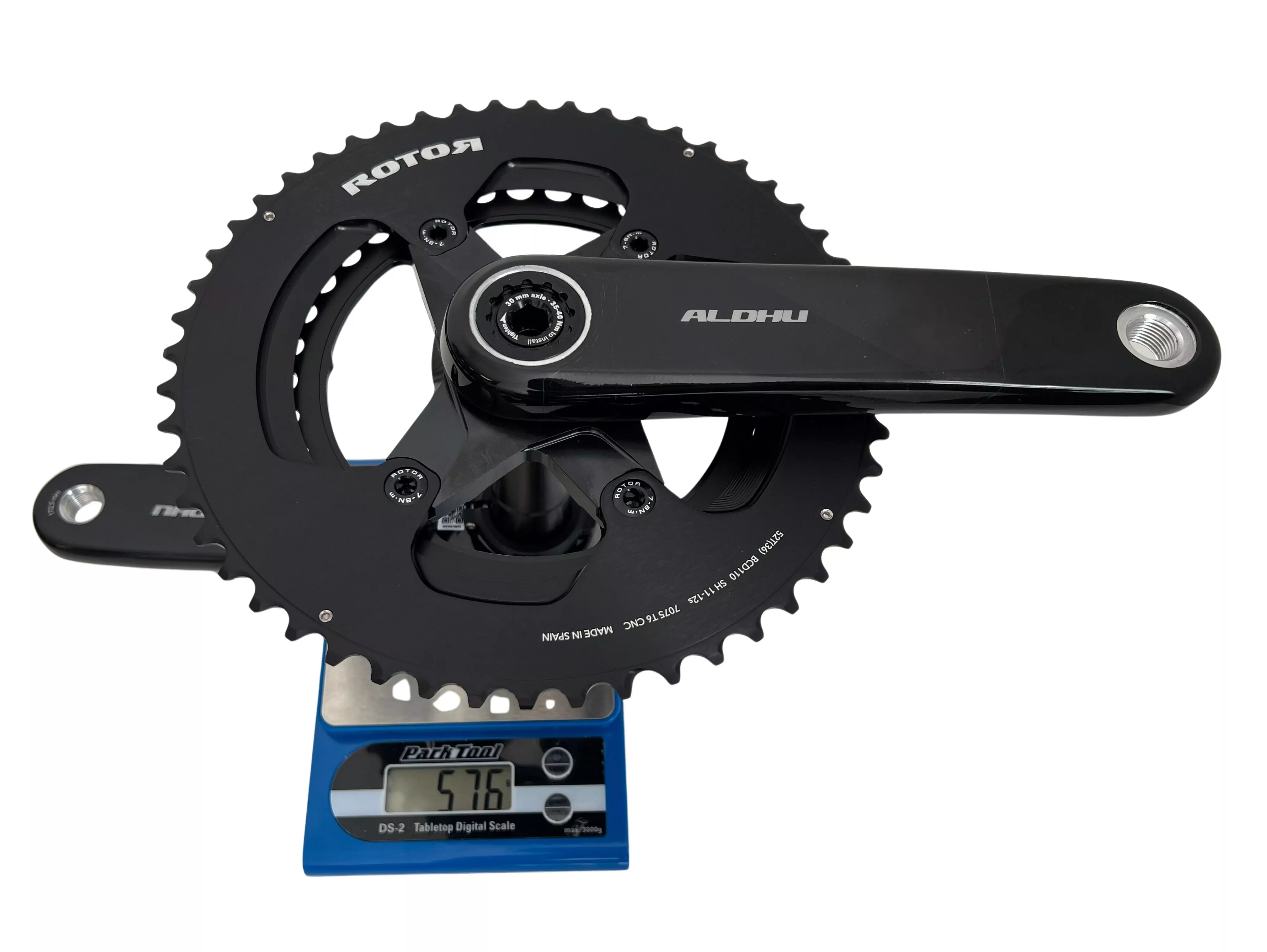
Rotor Aldhu Carbon
Velo-Perso reference figure in 170 mm / 50-34. Rotor’s strength is modularity: choose crank arms, spindle, chainrings, spider and optionally a power meter. The photo shows another real-world setup weighed at 576 g (172.5 mm / 52-36).
Velo-Perso measurements · weight depends on setup
Configure Aldhu Carbon →A note on the name “RACE SL”: QO also lists a separate RACE SL model claimed at 504 g on its website. This figure does not refer to the RACE Light currently sold and weighed by Velo-Perso. This separately announced model is not included in the ranking of cranksets featured here.
03 / Real-world evidence
Four workshop measurements, including two QO configurations
Velo-Perso photos and measurements complement manufacturer figures. Crank length and chainring sizes are specified because a weight figure only makes sense with its exact setup.

04 / Make the right upgrade
Do you really need to replace your Shimano crankset?
Sometimes keeping a perfectly good crankset and upgrading only the chainrings or adding power measurement makes more sense than buying the lightest option.
Keep your Shimano
Does your 105 or Ultegra still work well? An Alugear aero chainring kit updates its look and gearing. If you want power data, INPEAK lets you replace just the left crank arm on supported models.
Choose Rotor
With Rotor, an Aldhu Carbon can save weight while leaving room for future changes: crank length, 24/30 mm spindles depending on model, chainrings, INspider power meters and later upgrades.
Choose QO
The RACE AERO focuses on streamlined design and potential aero benefits; Velo-Perso weighed it at 672 g in 165 mm / 54-40. The Light focuses on saving grams, with an in-house measurement of 571 g in 165 mm / 50-34. Both require a compatible bottom bracket for the DUB 28.99 mm spindle.
05 / Related technical guides
Keep exploring our guides and finders
Weight, gearing, compatibility and power measurement should all be considered together before changing a crankset.
Explore the brands featured in this guide
Shimano is included as a benchmark; the linked brands lead to Velo-Perso selections, product information and advice.
06 / Frequently asked questions
Understand the weights before choosing
Which crankset is lightest in the 170 mm / 50-34 comparison?
Velo-Perso lists the Rotor Aldhu Carbon at 550 g in 170 mm / 50-34. QO claims 560 g for the RACE Light in that same configuration. However, our table prioritises the actual Velo-Perso measurement of 571 g in 165 mm / 50-34 for the RACE Light. These are documented setups, not a ranking of every crankset on the market.
QO RACE AERO or QO RACE Light: which should you choose?
Choose RACE AERO for its more enclosed design and potential aerodynamic benefits. QO claims 624 g in 170 mm / 50-34; Velo-Perso has also weighed it at 672 g in 165 mm / 54-40, which is competitive for an aero setup. The Light uses weight-saving parts and weighs 571 g as measured by Velo-Perso in 165 mm / 50-34 (QO claims 560 g in 170 mm / 50-34). No watt saving is claimed without comparative aerodynamic testing.
Why did Velo-Perso weigh the QO Light at 571 g when QO claims 560 g?
Our 571 g result concerns an actual 165 mm / 50-34 crankset. The 560 g figure is the manufacturer’s claim for 170 mm / 50-34. Without comparing every component and the weighing protocols, the difference cannot be explained by crank length alone.
How much did the QO RACE AERO weigh in your latest test?
The latest Velo-Perso measurement is 672 g for a QO RACE AERO in 165 mm / 54-40. This is a competitive result considering the aero spider and larger outer chainring.
Can QO RACE replace a Shimano 105 or Ultegra crankset?
Often yes, subject to frame and drivetrain compatibility. QO uses a 28.99 mm DUB-compatible spindle rather than Shimano’s 24 mm spindle, so another bottom bracket is usually required. Check our Bottom Bracket Finder and explore options from Bikone.
Is Rotor Aldhu Carbon always lighter than Shimano Dura-Ace?
In the documented 170 mm / 50-34 configuration, Aldhu Carbon weighs 550 g versus 685 g for Dura-Ace FC-R9200: a 135 g difference. This applies to those specific setups; chainrings, spider, crank length and a possible power meter affect weight.
What is the difference between Shimano FC-R8100 and R8150?
FC-R8100 is the Ultegra 12s crankset reference. R8150 relates to components in the Ultegra Di2 groupset, including the rear derailleur, rather than the crankset itself. Likewise, Dura-Ace FC-R9200 is the crankset, distinct from the R9250 Di2 derailleur designation.
Does an aero crankset always save watts?
Not necessarily. Streamlined chainrings and integrated shapes may reduce drag, but any actual benefit depends on speed, airflow around the frame, rider position and setup. We therefore speak of aerodynamic potential until verified comparative test data is available.
Do you need a new crankset to add a power meter?
No. On compatible Shimano cranksets, an INPEAK-equipped left crank arm INPEAK can be an affordable solution. Rotor also supports modular power-meter configurations with INspider or 2INpower.