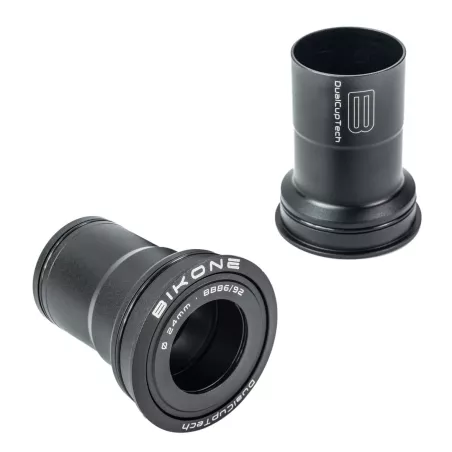
What is the BB86 standard?
BB86 is a road PressFit bottom bracket: frame width 86.5 mm, internal diameter 41 mm, designed for 24 mm spindles (Shimano Hollowtech II, Rotor 24 mm).
BB86 vs BB92: what’s the difference?
BB92 is the MTB variant with a wider shell (92 mm). The models listed here can span 86–92 mm, so they fit both BB86 and BB92 frames with 24 mm spindles.
How do I check if my bike is BB86?
Check your frame specs (BB86, BB86-41). Many road bikes (Canyon, Giant, Scott, BMC, Lapierre, Bianchi, Ridley, Wilier, etc.) use this standard. Also confirm your crank spindle type (24 mm).
Can I replace my Shimano SM-BB72-41B / SM-BB92-41B?
Yes. Every BB86 Ø41 / 24 mm bottom bracket on this page directly replaces those Shimano references on a compatible frame.
Which crank arms to use with BB86 Shimano ?
Most builds use Shimano Hollowtech II crank arms (Shimano 9/10/11/12-speed over the last 20 years). A BB86 for 24 mm spindles also accepts Rotor 24 mm cranks such as Aldhu 24 and Vegast 24.
Steel vs ceramic: which should I choose?
Steel = excellent value for daily use.
Ceramic = higher perceived smoothness and efficiency for performance.
Outcome also depends on bearing quality, sealing, and assembly/alignment.
Which BB86 should I pick for my budget?
- Budget: Bikone BB86 steel
- Best balance: CyclingCeramic BB86 (performant ceramic, serviceable)
- Max performance: Bikone BB86 ceramic
Is ceramic always faster?
Not always. Efficiency and lifespan come from the trio: bearing quality, seals, and assembly/alignment. A premium steel unit, properly installed, can outlast poorly maintained ceramic.
Typical weight of a BB86 Shimano bottom bracket?
Around 50–90 g depending on design. Weight differences are small; smoothness and durability matter more.
Can a BB86 creak? How do I prevent it?
Creaks usually come from poor alignment or insufficient/incorrect grease. Choose tight-tolerance cups, grease contact areas, and press with the proper tool to greatly reduce the risk.
Key takeaway: performance isn’t only about “ceramic.”
Bearing quality, sealing, and assembly/alignment are decisive.