
12-speed cassette spacing on the big chainring (52T): what the watts really say



Connect your watts to your gearing: our guide Why use a power meter? explains how to interpret your data to choose cassette and crankset better.
On the flat, your ability to hold a steady pace mainly depends on cassette spacing. We measure the difficulty of jumping to the next sprocket via the power gap to maintain at 52T – 90 rpm. The larger the gap, the more “painful” the shift feels at constant effort.
For years we’ve advised you on which chainring sizes to choose and which power meter to buy. But the essential link between power and gear choice was missing — a tough exercise because road cycling is physics in motion, with internal and external parameters changing several times per second. The purpose of this page is not to declare the “best” cassette, but the one that best fits your use.
Protocol & assumptions (rigorous, without useless jargon)
Velo-Perso empirical base: long-term compilation of rides from the same rider (≈ 1.80 m / 75 kg). Goal: anchor a realistic power ↔ speed relationship.
Theoretical model (flat, no wind): Canyon Aeroad (aerodynamic “frame-only” reference at 45 km/h, extrapolated v³), aero-hoods posture, slick road tire Crr, 3% drivetrain losses. Calculations at 52T – 90 rpm, 700×25C wheel (2.105 m).
Reliability range: robust from 28 to 35 km/h. Below, teasing apart frictions gets tricky; above, aero makes tiny speed changes explode into big power gaps.
Reading it right: the same method applies to two successive sprockets. A small absolute error carries to the next one. The power gap remains the relevant indicator to judge spacing.
What the numbers show (useful in practice)
In the middle of the cassette — your cruising speeds — a step of one tooth often creates about ≈ 50 W difference. A gentle false flat can gain or lose those 50 W: you shift.
The real trap is two-tooth jumps in mid-range (e.g. 15 → 17): we approach 100–120 W. Going from 17 to 15 on the flat can move you one to three training zones: too spinny on 17, in the red on 15.
Conversely, large gaps on the small sprockets (11–12–13) are less of a concern: you use them mostly in descents or sprints. Down the cassette, absolute speed and power are low: even a four-tooth step has limited impact on the flat.
Comparison of the 4 cassettes (52T – 90 rpm)
Calculation: Velo-Perso.com — speeds, powers and “power gaps to the next sprocket” are computed cell-by-cell for each cassette.
| Shimano DA / Ultegra 11–30 | Shimano 11–34 | Shimano 105 11–36 | ROTOR UNO 11–36 | ||||||||||||
|---|---|---|---|---|---|---|---|---|---|---|---|---|---|---|---|
| Sprocket | Speed (90 rpm) | Required power | Δ → next sprocket | Sprocket | Speed (90 rpm) | Required power | Δ → next sprocket | Sprocket | Speed (90 rpm) | Required power | Δ → next sprocket | Sprocket | Speed (90 rpm) | Required power | Δ → next sprocket |
Assumptions: 1.80 m / 75 kg · 52T at 90 rpm · 700×25C wheel (2.105 m) · Canyon Aeroad (aero “frame-only” reference at 45 km/h, extrapolated v³) · aero-hoods position · slick-road Crr · 3% drivetrain losses.
Practical analysis, case by case
Dura-Ace / Ultegra 11–30: 11 to 17 in single-tooth steps → smooth transitions, moderate gaps; “silky” spacing to ride fast.
Shimano 11–34: missing 16T → the 15 → 17 jump is the trickiest (≈ 100–120 W). Down low, bigger steps but limited impact on the flat.
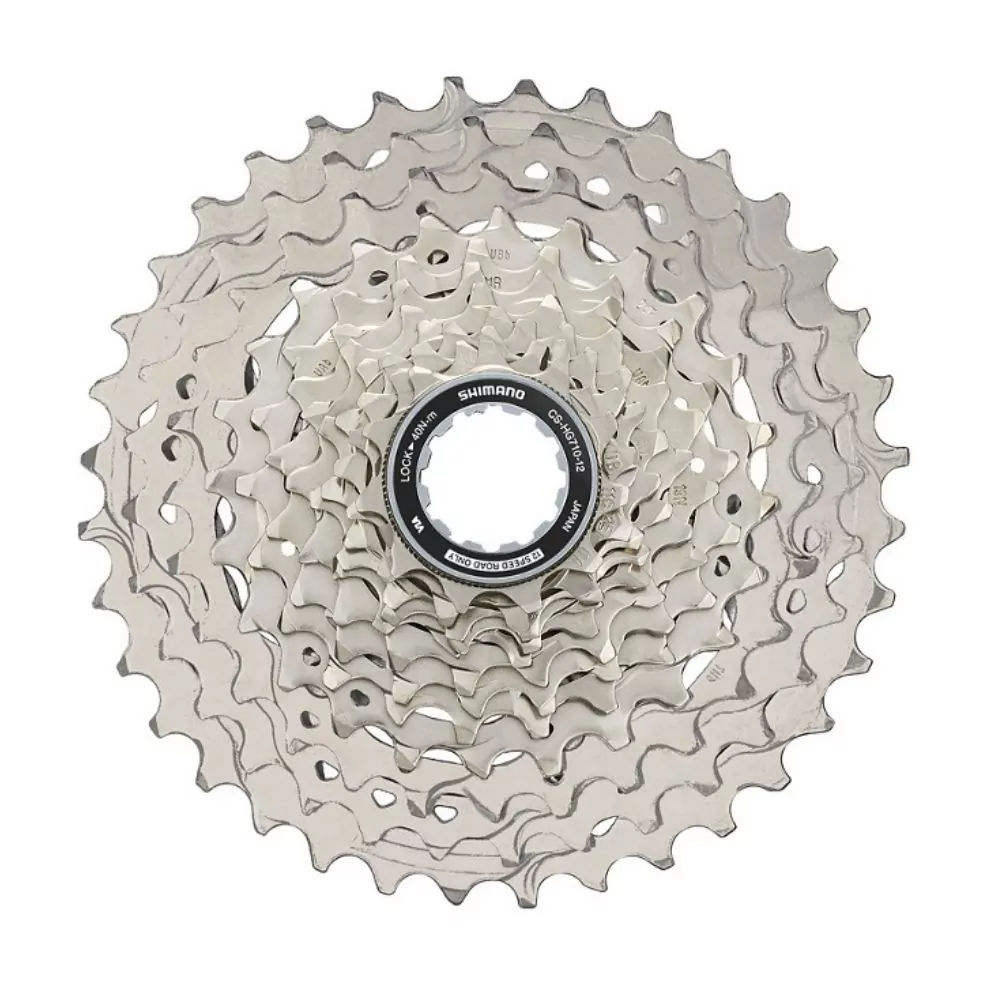
Shimano 105 11–36: same 16T “hole”. The end (24–28–32–36) is mostly for hills; limited flat impact.
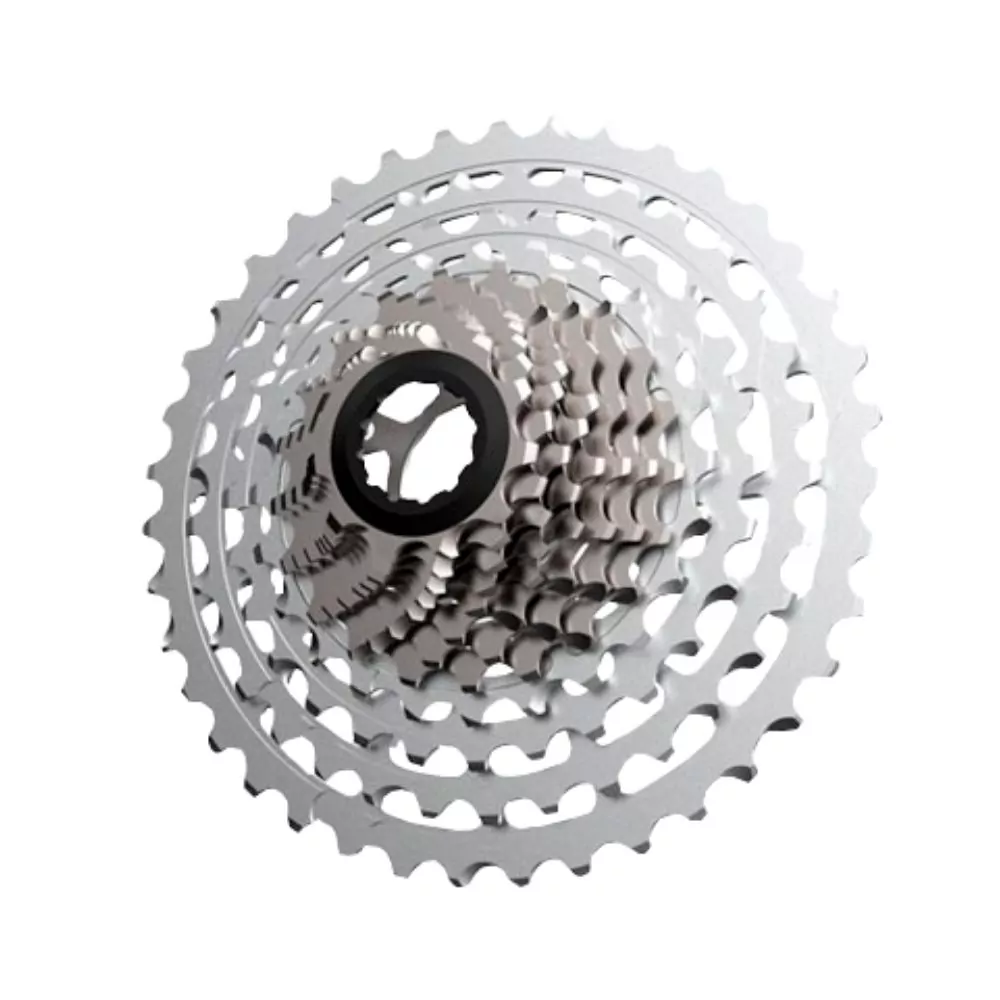
ROTOR UNO 11–36: 16T also missing. Low end 24–27–31–36: the 27 → 31 jump happens a bit higher in speed than 24 → 28, so slightly more noticeable. Compatibility: rear derailleur 105 or GRX Di2 only. Explore the ROTOR UNO 11–36 cassette.
Cassette weight & real-world impact on efficiency
| Cassette | Range | Weight (ref.) | Key takeaways |
|---|---|---|---|
| Dura-Ace R9200 | 11–30 / 11–34 | 223 g / 253 g | Fine top-end spacing; excellent on the flat |
| Ultegra R8100 | 11–30 / 11–34 | 291 g / 345 g | Great weight/price balance, same spacing logic |
| 105 (CS-HG710) | 11–36 | 391 g | Wide range for hills/endurance |
| ROTOR UNO | 11–36 | 230 g | End 24-27-31-36; compatible with 105/GRX Di2 only |
The cassette’s weight has a moderate impact on the flat. However, +100 g penalties start to be felt (accelerations, inertia). In a 105-level groupset, the cassette and crankset hurt pure efficiency the most… yet the 11/36 range can be a real asset depending on terrain.
Do I need an 11-tooth start?
Two cases where the 11T makes sense:
1) Sprints / fast pulls: having around 1000 W peak helps drive the 11T efficiently.
2) Mountain descents: some climbers with low peak power prefer to keep pedalling to maintain speed; the 11T becomes handy.
The rest of the time, the 11T start is often an industrial simplification. If you rarely use it, a cassette well-spaced from a 12T start is often more pleasant day-to-day.
Free guides & Velo-Perso selection
At Velo-Perso.com, we offer free guides to orient you, personalise your experience, and help you choose products from specialist brands focused on efficiency and modularity.
Final key points
The most “missing” sprocket is still 16T (hence the notorious 15 → 17 mid-range jump). 18T also goes missing: between 17 and 19 you often see ~70 W to manage on the flat — right in everyday speeds.
To ride fast and “silky” on 52T: choose spacing that keeps the intermediate teeth (11–30 leads). For versatility (flat + hills): 11–34 / 11–36 work great, provided you anticipate the 15 → 17 jump (vary cadence by 2–4 rpm, tweak posture and aero).