


Access the complete guide: route, gearing, training tips and race strategy
ÉTAPE DU TOUR 2026 • COURSE ROUTE ANALYSIS
Where does the real difficulty hide? In the gradient distribution.
Étape du Tour 2026 isn’t just a single elevation number or a checklist of climbs. In the mountains, it’s the gradients—and how they’re distributed that dictate fatigue, pacing, and your ability to hold the effort for hours.
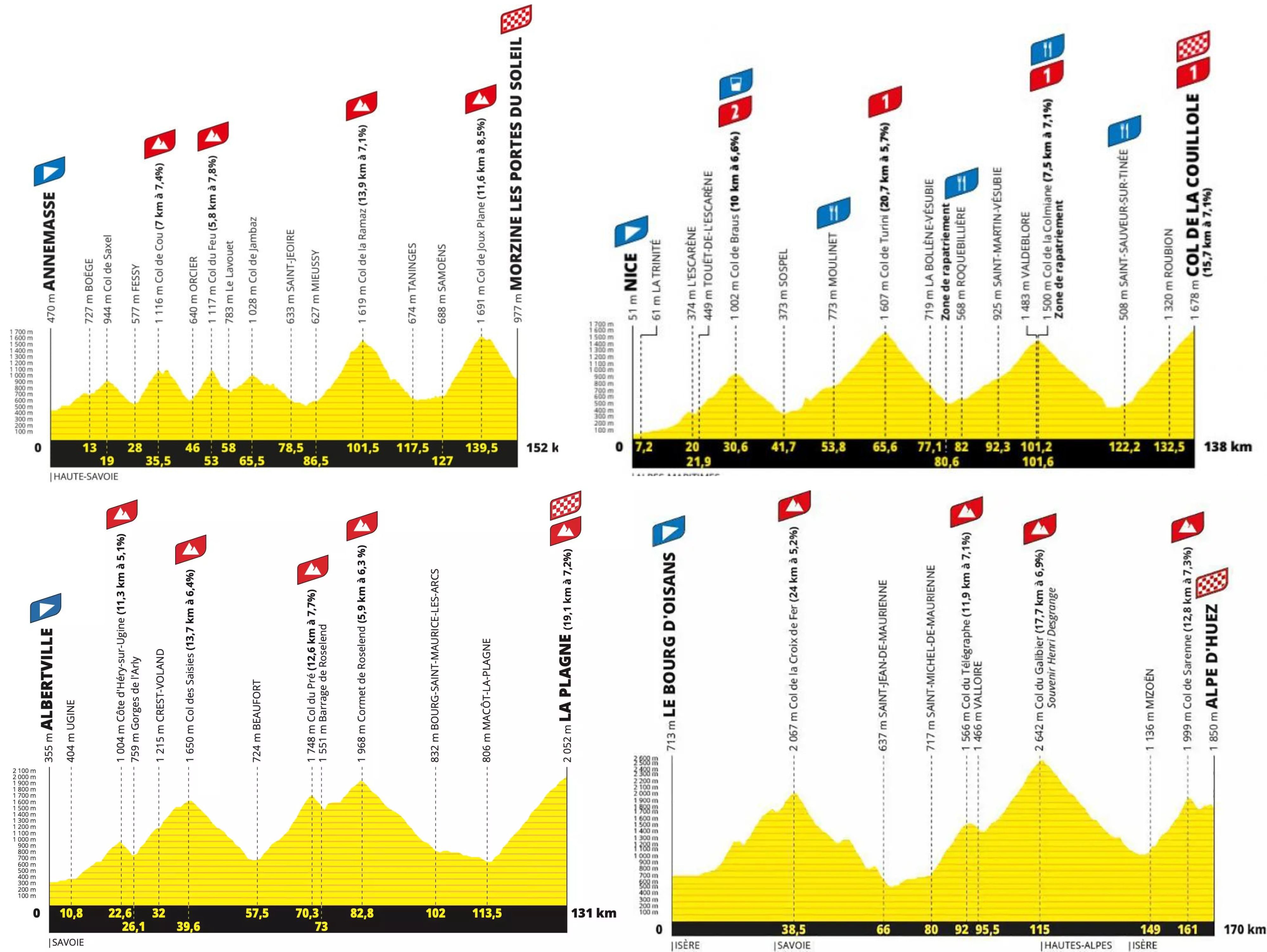
On this page, we break down the route with a very practical lens: kilometres above 5% grouped by gradient bands, comparison with previous editions, then a climb-by-climb analysis — including key combinations like Telegraphe + Galibier, often “heavier” than they look on paper.
Goal: understand (no wishful thinking) where the event will truly be decided — before we even talk training, gearing, or equipment.

| Edition | Climb | 5–6% | 6–7% | 7–8% | 8–9% | 9–10% | 10–11% | 11–12% | Total (Δ+) |
|---|---|---|---|---|---|---|---|---|---|
| EDT 2023 | |||||||||
| EDT 2023 | Cou | 1 | 2 | 1 | 2 | 1 | 0 | 0 | 7 |
| EDT 2023 | Feu | 1 | 0 | 1 | 4 | 0 | 0 | 0 | 6 |
| EDT 2023 | Ramaz | 1 | 4 | 3 | 3 | 1 | 0 | 1 | 13 |
| EDT 2023 | Joux Plane | 0 | 2 | 2 | 2 | 6 | 0 | 0 | 12 |
| EDT 2024 | |||||||||
| EDT 2024 | Braus | 3 | 3 | 1 | 2 | 0 | 0 | 0 | 9 |
| EDT 2024 | Turini | 5 | 4 | 2 | 4 | 0 | 0 | 0 | 15 |
| EDT 2024 | Colmiane | 0 | 3 | 4 | 0 | 0 | 0 | 0 | 7 |
| EDT 2024 | Couillole | 0 | 3 | 7 | 6 | 0 | 0 | 0 | 16 |
| EDT 2025 | |||||||||
| EDT 2025 | Héry sur Ugine | 7 | 4 | 3 | 2 | 0 | 0 | 0 | 16 |
| EDT 2025 | Saisies | 2 | 2 | 1 | 6 | 1 | 0 | 0 | 12 |
| EDT 2025 | Pré | 1 | 1 | 2 | 2 | 3 | 1 | 1 | 11 |
| EDT 2025 | Roselend | 1 | 2 | 1 | 1 | 0 | 0 | 0 | 5 |
| EDT 2025 | La Plagne | 2 | 3 | 6 | 2 | 3 | 0 | 0 | 16 |
| EDT 2026 | |||||||||
| EDT 2026 | Croix de Fer | 3 | 5 | 3 | 2 | 3 | 1 | 1 | 18 |
| EDT 2026 | Telegraphe | 1 | 2 | 7 | 2 | 0 | 0 | 0 | 12 |
| EDT 2026 | Galibier | 2 | 1 | 3 | 6 | 2 | 1 | 0 | 15 |
| EDT 2026 | Telegraphe + Galibier simulation | 3 | 3 | 10 | 8 | 2 | 1 | 0 | 27 |
| EDT 2026 | Sarenne | 1 | 1 | 3 | 1 | 3 | 1 | 0 | 10 |
| EDT 2026 | Alpe d’Huez | 1 | 0 | 0 | 0 | 0 | 0 | 0 | 1 |
This table is designed to help you benchmark yourself if you know the climbs from previous editions — and even better if you’ve ridden a real Étape du Tour before. In the mountains, it’s not just total elevation gain that matters: the gradient is the key factor, because you simply don’t ride the same way at 6% as you do at 9%.
It will help you visualise EDT 2026 in concrete terms. Love steep gradients? Here you can spot them quickly and compare them to climbs you already know.
• Croix de Fer and Sarenne: irregular climbs, with brutal ramps… but also easier sections where you can recover if you pace it right.
• Telegraphe: a steady but endless gradient. It’s exactly the kind of climb where you can burn matches without even noticing.
• Galibier: a crescendo challenge. It’s the true judge of this edition. Its difficulty is often underestimated, because altitude will play a major role: everyone will lose a bit of power up there.
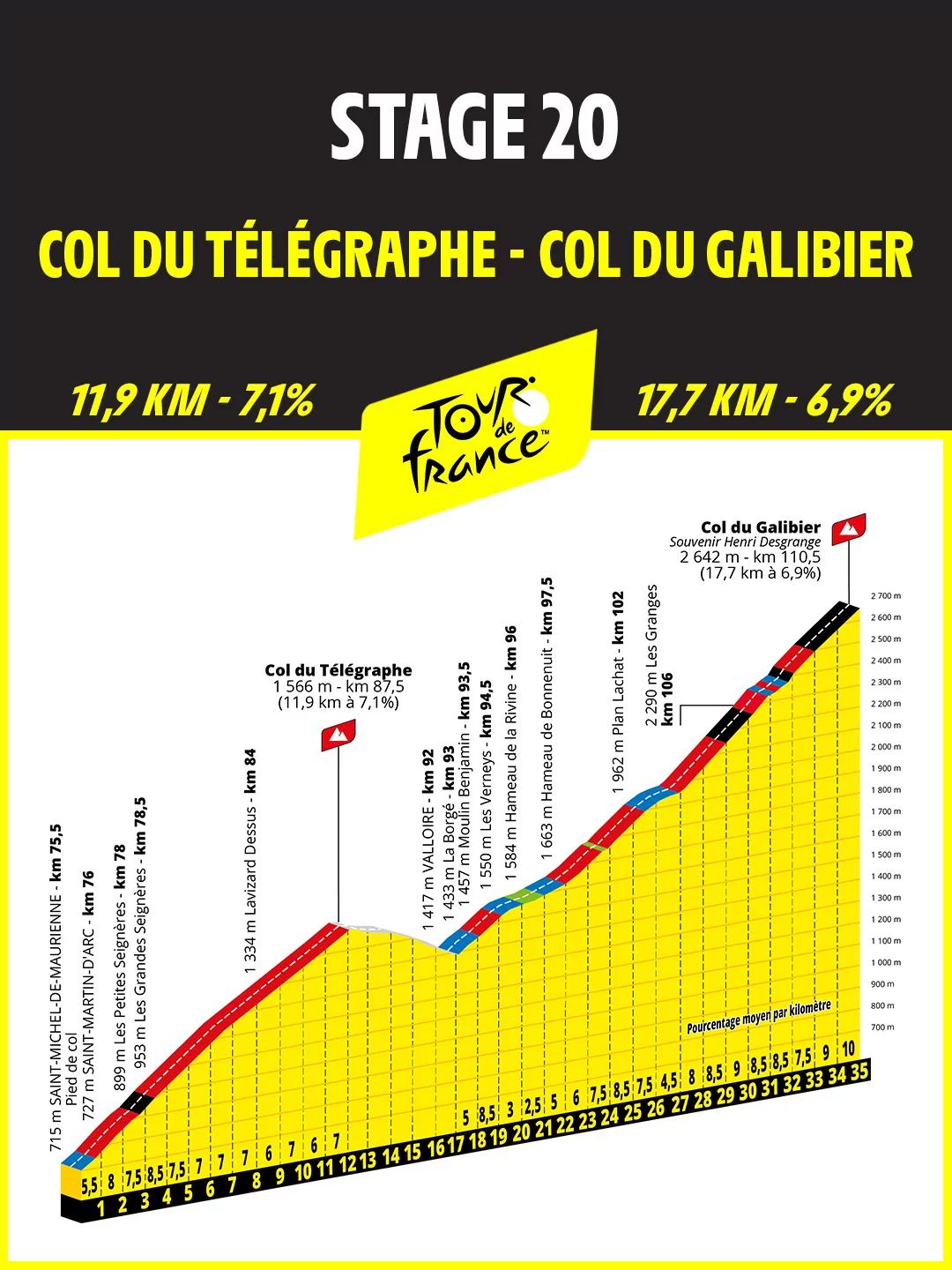
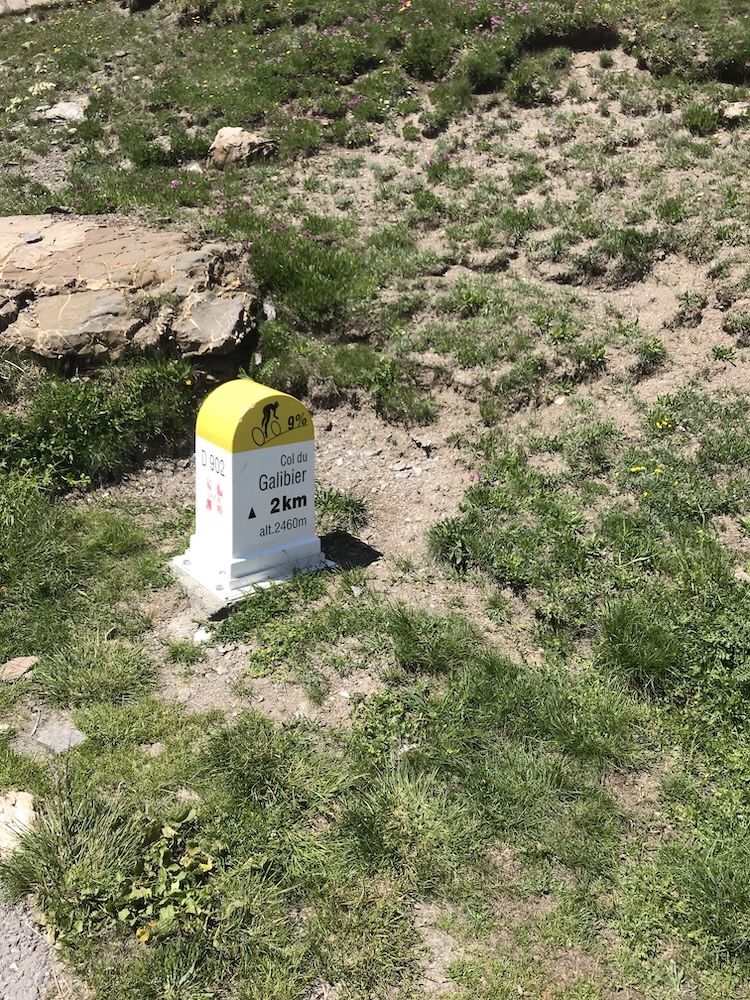
The final 7 kilometres of the Galibier sit at over 2000 m of altitude, a situation rare in recent Étape du Tour editions.
Build it into your expectations now: on the final section, you will lose power, and therefore speed. Even with excellent preparation, this effect is unavoidable.
If you have access to a very structured build-up, an altitude training camp in the month before the event can help you get over the Galibier with far more ease.
In Sarenne, the return to steep gradients will mostly punish how well you’ve fuelled, both solids and fluids.
Altitude there remains manageable: you shouldn’t be completely out of breath, but you can quickly end up out of energy or dehydrated if your fueling plan wasn’t dialled in.
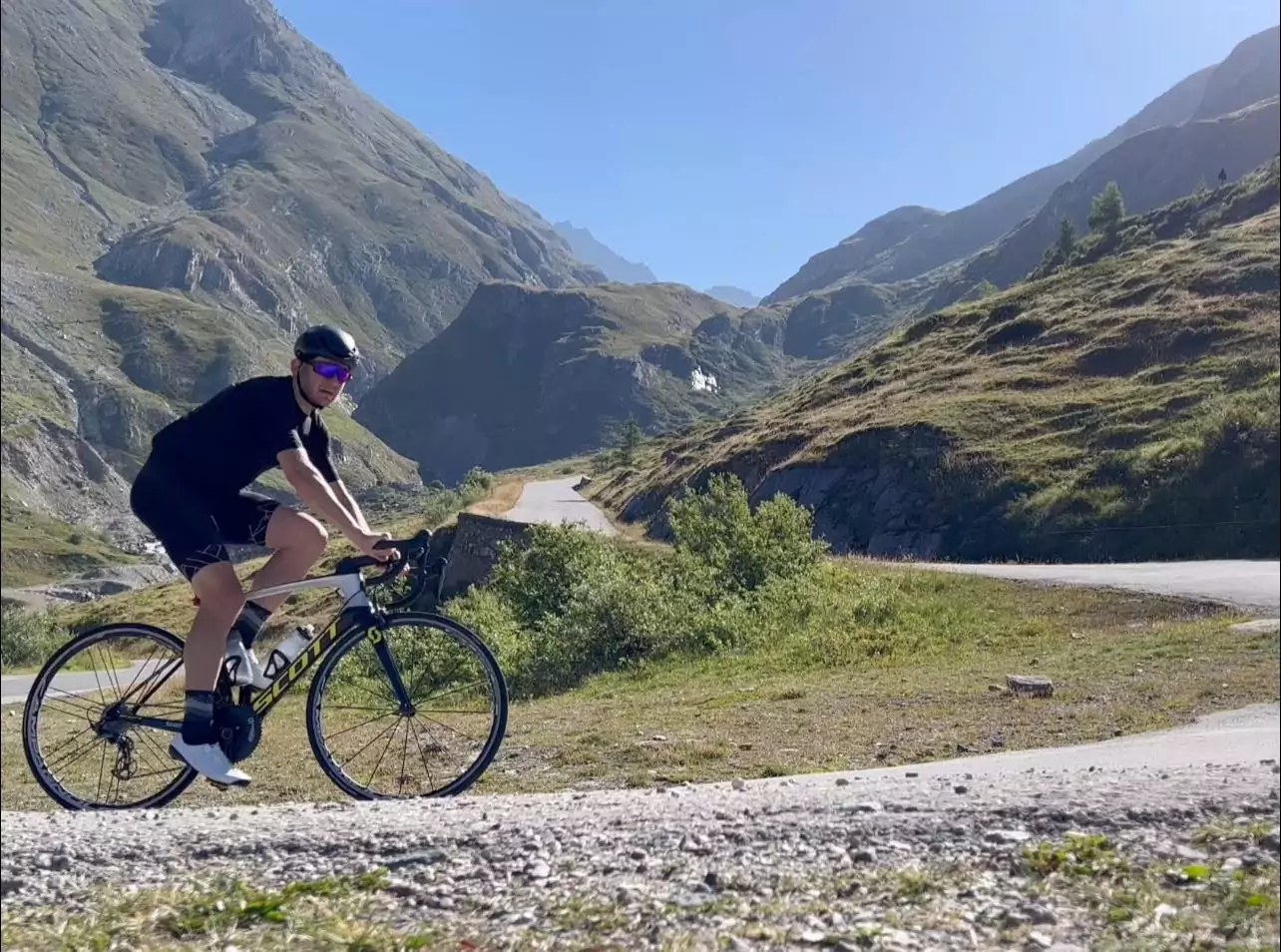
THE VELO-PERSO.COM TAKEAWAY
2026: an edition apart probably the toughest.
This 2026 edition is probably the most demanding ever. Galibier has already been on the menu (notably the year Pierre Rolland won on Alpe d’Huez), but this time you also have the Col de la Croix de Fer, which lengthens the route and drains the body early. The total elevation gain may look manageable, because it’s “only” about 10% higher than other tough editions… but it hides the true judge: the final 7 kilometres of the Galibier, at high altitude.
With a finish time around 10 hours for many riders, you’ll probably go through every emotion in one day. The route is one thing, your pacing and decision-making is another: you’ll get through the hardest sections far better if you are prepared well in advance.
FAQ • Étape du Tour 2026: the real difficulty (no wishful thinking)
Segmented FAQ: back of the pack / mid-pack / front pack. Goal: help you avoid mistakes and understand why the Galibier (gradient + length + altitude) is the true judge of 2026.
Don’t underestimate 2026: the key is consistency over 10–12 hours
Q Is Étape du Tour 2026 too hard for a back-of-the-pack rider?
Yes—2026 must not be taken lightly. This is not an edition you can “manage as usual”. The difficulty comes from accumulation (distance + climbs + fatigue), with a very demanding finale on the Galibier.
For back-of-the-pack riders, the challenge is not speed. It’s holding a moderate effort for a very long time, without breaking.
Q What’s the real risk in 2026 if I’m “on the limit”?
The main risk is a DNF. Many riders feel “okay” until the Télégraphe, then gradually empty out and have no margin left on the Galibier.
Key takeaway: in 2026, consistency (pacing + endurance) matters more than raw performance.
Q I was barely okay in 2025—can I finish 2026?
Let’s be very clear: if you were among the last riders in 2025, you will likely not finish 2026 without a major change in your preparation.
- Significantly more volume: thousands of extra kilometres across the year
- Ability to hold your usual long-ride pace 1–2 hours longer
- Real “climbing legs” preparation (even in mid-mountains)
Realistic goal: finish in a similar position as 2025… by riding more
Q Is the Galibier really the scare factor of this edition?
Yes: it’s the hardest climb of the last 4 editions (2023–2026), and arguably one of the hardest in France for an amateur event, because it combines gradient + length + altitude.
Even if other climbs are longer, steeper or higher, the Galibier is the one that’s hard everywhere—and very late in the day.
Q If I finished EDT 2025 mid-pack, can I do the same in 2026?
Yes—this is realistic, on one clear condition: ride more. 2026 rewards endurance. Being able to hold your usual long-ride pace 1–2 hours longer can completely change your result.
Q Where can you recover on the 2026 course?
There are useful recovery zones if you use them well:
- some flatter sections in the Croix de Fer descent
- the Maurienne valley before the Télégraphe
- after Valloire in less steep gradients
- the flatter sections in the Lautaret descent
Important: these phases are for restoring balance (fuel + hydration), not “making time”.
Strategy: groups, avoid early red-zone, and accept lower power at altitude
Q Where will the event be decided for the strongest riders?
Very early: get into the right groups, don’t go too deep too soon, then ride the Galibier at the right effort. In 2026, a “clean race” often beats over-aggression.
Q Why will my watts be much lower on the Galibier?
Because of altitude: the final 7 kilometres above 2000 m cause an inevitable power drop. This does not automatically mean a worse result—everyone is affected.
Key takeaway: lower power ≠ worse ranking. In 2026, the Galibier is a physiological judge.
Q Is altitude training useful? And is doing La Marmotte beforehand a good idea?
Yes. Front-pack riders have the most to gain from an altitude camp—and often the time to integrate it properly.
Doing La Marmotte beforehand is arguably the best possible choice for this profile: mountains, pacing, repeated long efforts.
Preparation: training first, equipment second (and at the right time)
Q Is equipment more important than training?
No. Training is the #1 factor for this event. Equipment mainly helps you avoid mistakes (too-big gearing, sloppy pacing), but it never replaces volume.
Q I will ride more in 2026—what other key advice would you give?
- Gearing: going 2–3 teeth easier on the small chainring can be a smart choice for this edition.
- Pacing control: if you didn’t use a power meter in 2025, get one early. Over 8–10 hours, poor pacing can cost dozens of minutes.
Q Is mountain preparation useful even without going to altitude?
Yes. Even if “high altitude” only affects the very end of the Galibier, the priority over 170 km is having real climbing legs: climb lots of hills and passes, even in mid-mountain areas.

Olivier from velo-perso.com
Behind these tips is my journey as a competitor (former Elite N1 and pro trainee) and a deep passion for the technical side of cycling. I've known the podiums, but I've also experienced the failure of finishing 600th at the Étape du Tour due to major strategic mistakes. Since 2012, I’ve used power meters to decode the physics of performance. My goal? To share this experience so that every ride—from the Galibier to the Rockies—remains a pleasure above all.
"Take it step by step, but stay ambitious!"


