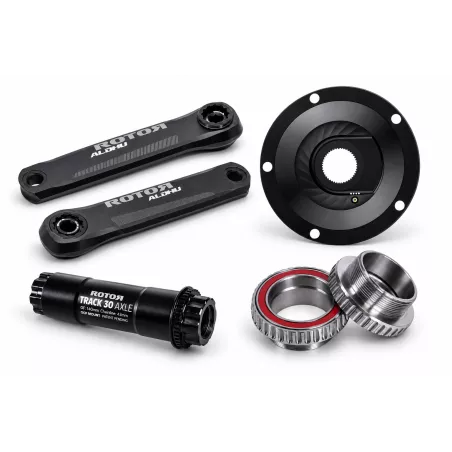
The ROTOR track range is built around three modular crankset platforms: VEGAST Track, ALDHU Track and ALDHU Carbon Track. Velo-Perso also offers an exclusive ALDHU XCADEY build with a power meter, so you can record every watt on the velodrome. Choose according to your event, preferred crank length and training goals.

The common platform: ROTOR Track30
The three standard cranksets share the same architecture: a short 30 mm track spindle paired with a five-arm, 144 mm BCD track spider. In the standard configurations shown here, this produces a 140 mm Q-factor and 43 mm chainline. On the ALDHU XCADEY build, the final chain alignment must be checked on the bike.
Track30 is modular: VEGAST 30, ALDHU 30 and ALDHU Carbon crank arms can be used with this track architecture. You can therefore change your crank arms without necessarily replacing the entire crankset.
Three ROTOR track cranksets

ROTOR VEGAST Track
- Forged 6082-T6 aluminium.
- 165 / 170 / 172.5 / 175 mm.
- Outstanding durability.
- Competitive weight.
- Excellent performance for the price.
A sensible choice for young racers, clubs, regional-level competitors and premium fixed-gear builds. Its stiffness readily handles the repeated accelerations above 1,000 W often seen in track racing.
Explore VEGAST Track
ROTOR ALDHU Track
- CNC-machined 7075-T6 aerospace-grade aluminium.
- 150 to 175 mm.
- Exceptional choice of crank lengths.
- Very high stiffness.
- Exceptionally robust construction.
Our preferred choice for sprint, match sprint, keirin, 500 m and kilometre events. We have received excellent feedback from track racers producing close to 2,000 W.
Explore ALDHU Track
ROTOR ALDHU Carbon Track
- High-modulus carbon-fibre crank arms.
- 255 to 263 g for the pair of arms.
- Exceptionally low weight.
- High stiffness.
- A more vibration-damping feel than aluminium.
If we were building a crankset today for individual or team pursuit, ALDHU Carbon would be our first choice.
Explore ALDHU Carbon TrackTrack crankset with power meter: ROTOR ALDHU XCADEY
ROTOR ALDHU × XCADEY XPOWER-S Gen2
We have combined ROTOR ALDHU 30 crank arms, the short Track30 spindle and a five-bolt, 144 BCD XCADEY power-meter spider to build a premium crankset specifically for track cycling. The ROTOR BSA30 Track bottom bracket is included.
Measure your total power and cadence. Compare standing starts, sprints and pursuits, then review the data on a compatible ANT+ or Bluetooth device. XCADEY claims ±1% accuracy.
Chainring not included; sold separately. The mechanical assembly has been checked by Velo-Perso.com. Supplied bottom bracket fits a 68 mm threaded BSA shell; always confirm frame compatibility and final chainline before riding.
Power training on the velodrome
Quick comparison
| Model | Construction | Crank lengths | Key benefit | Recommended events |
|---|---|---|---|---|
| VEGAST Track | Forged 6082-T6 aluminium | 165–175 mm | Durability / value | Club, all-round riding, regional racing, fixed gear |
| ALDHU Track | CNC-machined 7075-T6 aluminium | 150–175 mm | High power / crank-length range / durability | Sprint, keirin, 500 m, kilometre |
| ALDHU XCADEY | ALDHU CNC 7075-T6 arms + XCADEY power-meter spider | 150 / 155 / 160 / 165 / 170 / 172.5 / 175 mm | Total power and cadence · ANT+/Bluetooth · BSA bottom bracket included | Power-based training, sprint, keirin, pursuit |
| ALDHU Carbon Track | High-modulus carbon fibre | 155–175 mm, subject to availability | Low weight / stiffness / riding feel | Individual and team pursuit |
| ROTOR 2INpower Track | Crankset with true independent left/right power measurement | 172.5 / 175 mm (last remaining sizes stated) | Independent L/R data and advanced analysis | Technical performance monitoring and bilateral power analysis |
Which crankset suits your track event?
Want to track your watts? ALDHU XCADEY measures total power at the spider and cadence. ROTOR 2INpower Track goes further by measuring left- and right-leg power independently. Each approach serves a different analysis need.
Why are shorter crank arms common in track cycling?
Track racing often combines high power with extremely high cadence. Shorter crank arms reduce the range of motion and can make it easier to maintain smooth pedalling at high rpm.
165 mm is a popular choice, but there is no single ideal length. Rider physiology, racing event and preferred cadence must all be considered.
Aluminium ALDHU offers an especially wide range: 150 / 155 / 160 / 165 / 167.5 / 170 / 172.5 / 175 mm. The 167.5 mm option is made to order, with an indicative eight-week lead time.
A modular platform that grows with young track riders
One of the greatest benefits of the ROTOR system is its modularity. A young rider can start with shorter cranks suited to their height, then replace only the crank arms as they grow.
Chainrings can be changed independently too. As a rider progresses, gearing can be increased without replacing the whole crankset. With lengths starting at 150 mm, ALDHU is particularly suitable for such a build.
Track chainrings: 144 BCD and 45–56 teeth
VEGAST Track, ALDHU Track and ALDHU Carbon Track all use a five-bolt, 144 mm BCD track spider. ALDHU XCADEY retains the same fixing standard through its 144 BCD power-meter spider.
ROTOR NoQ Track chainrings are available from 45 to 56 teeth, subject to stock.
Since 144 BCD is widely used in track cycling, other five-bolt track chainrings using the same standard will normally be compatible.
Which bottom bracket fits the Track30 spindle?
The Track30 spindle is shorter than a standard 30 mm road spindle. This is what makes it possible to achieve the narrow geometry sought after on the velodrome.
For a threaded BSA frame, ROTOR offers a dedicated BSA30 Track bottom bracket. The VEGAST, ALDHU and ALDHU Carbon product pages let you choose a configuration with or without a bottom bracket. The ALDHU XCADEY comes with a BSA30 Track bottom bracket for a 68 mm shell included in the €699 price.
ROTOR 2INpower Track: true independent left/right measurement

Integrated dual-sided track power meter
ROTOR 2INpower Track incorporates four pairs of strain gauges, measuring left- and right-leg power independently, along with cadence, OCA and OCP metrics. Unlike ALDHU XCADEY, which measures total power at the spider, 2INpower provides separate readings for each leg.
It uses a 30 mm spindle and a five-bolt 144 mm BCD track spider.
Only 172.5 mm and 175 mm crank lengths remain. These are the last available units.
Explore ROTOR 2INpower TrackVelo-Perso.com's take
The best track crankset cannot be chosen solely by the number of watts a rider produces. The type and duration of effort matter just as much.
For younger riders, clubs and all-round use, VEGAST already offers excellent stiffness and impressive durability. For sprint, keirin and high-power kilometre efforts, our preference is the 7075-T6 aluminium ALDHU.
For individual or team pursuit, we would choose ALDHU Carbon instead. Its low weight helps with acceleration, its stiffness is fully suited to the demands of the event, and the carbon arms provide a more vibration-damping feel during sustained efforts.
With ALDHU XCADEY, our aim was to offer track riders a complete, premium crankset with an integrated power meter. It is a compelling tool for comparing standing starts, monitoring peak sprint watts and measuring progress from session to session.
Still deciding which crankset is right for you?
Use our crankset finder to narrow down the most suitable platform and crank length for your riding.
Frequently asked questions about track cranksets
What is the difference between VEGAST, ALDHU and ALDHU Carbon Track?
VEGAST uses forged 6082-T6 aluminium arms and offers outstanding durability and value. ALDHU uses CNC-machined 7075-T6 aluminium, with crank lengths from 150 to 175 mm, and is particularly suited to high-power racing. ALDHU Carbon features much lighter high-modulus carbon arms and is our first choice for pursuit events.
Which crankset is best for sprint, keirin or the kilometre?
We favour the aluminium ALDHU. Its CNC-machined 7075-T6 construction combines high stiffness, direct power transfer and exceptional durability. We have received excellent feedback from riders producing close to 2,000 W.
Which crankset should I choose for pursuit racing?
Our first choice for both individual and team pursuit is ALDHU Carbon Track. Its low weight helps with acceleration, its stiffness handles high power and the carbon arms offer a more vibration-damping ride during sustained efforts.
What crank length should I use on the track?
165 mm is very common but is not a universal rule. Shorter arms can help some riders maintain cadence at high rpm. The best choice also depends on body proportions and racing discipline. ALDHU offers an exceptionally wide 150 to 175 mm range.
Which crankset works best for a young track cyclist?
ALDHU is particularly appealing thanks to options starting at 150 mm and its modular design. As a rider grows, they can change the crank arms alone while keeping the compatible spindle, spider and other components.
What is the ROTOR Track30 system?
Track30 is ROTOR's dedicated track architecture, built around a short 30 mm spindle and a five-bolt, 144 mm BCD spider. The standard builds shown here have a 140 mm Q-factor and a 43 mm chainline. Final chain alignment should be checked on custom builds such as ALDHU XCADEY.
Which chainrings fit ROTOR Track cranksets?
The three standard models use five-bolt 144 mm BCD track spiders, and ALDHU XCADEY uses the same bolt circle through its power-meter spider. Velo-Perso offers ROTOR NoQ Track chainrings in sizes from 45 to 56 teeth, subject to availability.
Can I use road chainrings on a ROTOR track crankset?
Most modern road chainrings use a different bolt pattern. You must fit a chainring compatible with the five-bolt, 144 mm BCD track spider.
Can I use an oval chainring on a fixed-gear track bike?
The ROTOR NoQ track chainrings offered here are round. On a fixed-gear drivetrain, an oval chainring can cause chain tension to vary through the pedal stroke. We recommend an oval option only when the manufacturer explicitly approves it for fixed-gear track use.
Are carbon crank arms stiff enough for track racing?
Yes. ALDHU Carbon is a competition-ready track crankset that can handle high power. We especially recommend it for pursuit, thanks to its balance of weight and stiffness. For extreme-power sprints and disciplines with greater crash exposure, we prefer the durable aluminium ALDHU.
Is there a ROTOR track crankset with a power meter?
Yes. ROTOR ALDHU XCADEY measures total power at the spider and cadence, sending data by ANT+ or Bluetooth. ROTOR 2INpower Track independently measures power from the left and right legs and offers advanced metrics. The last available 2INpower Track sizes are stated as 172.5 and 175 mm.
Are the chainring and bottom bracket included with ALDHU XCADEY?
The €699 VAT-inclusive price covers the ALDHU crank arms, Track30 spindle, XCADEY power-meter spider and ROTOR BSA30 Track bottom bracket for a 68 mm threaded BSA shell. The five-bolt, 144 mm BCD track chainring is sold separately.
Does ALDHU XCADEY measure left- and right-leg power independently?
No. The XCADEY spider measures total power. Any left/right balance reported by a connected device is an estimate, not two separate power measurements. Choose ROTOR 2INpower Track if you need genuinely independent left- and right-leg power data.
Which bottom bracket should I use with ROTOR Track30?
ROTOR makes a dedicated BSA30 Track bottom bracket for the short 30 mm track spindle. On the VEGAST, ALDHU and ALDHU Carbon product pages, you can select a version with or without a bottom bracket. ALDHU XCADEY includes the BSA30 Track bottom bracket for a 68 mm BSA shell.